
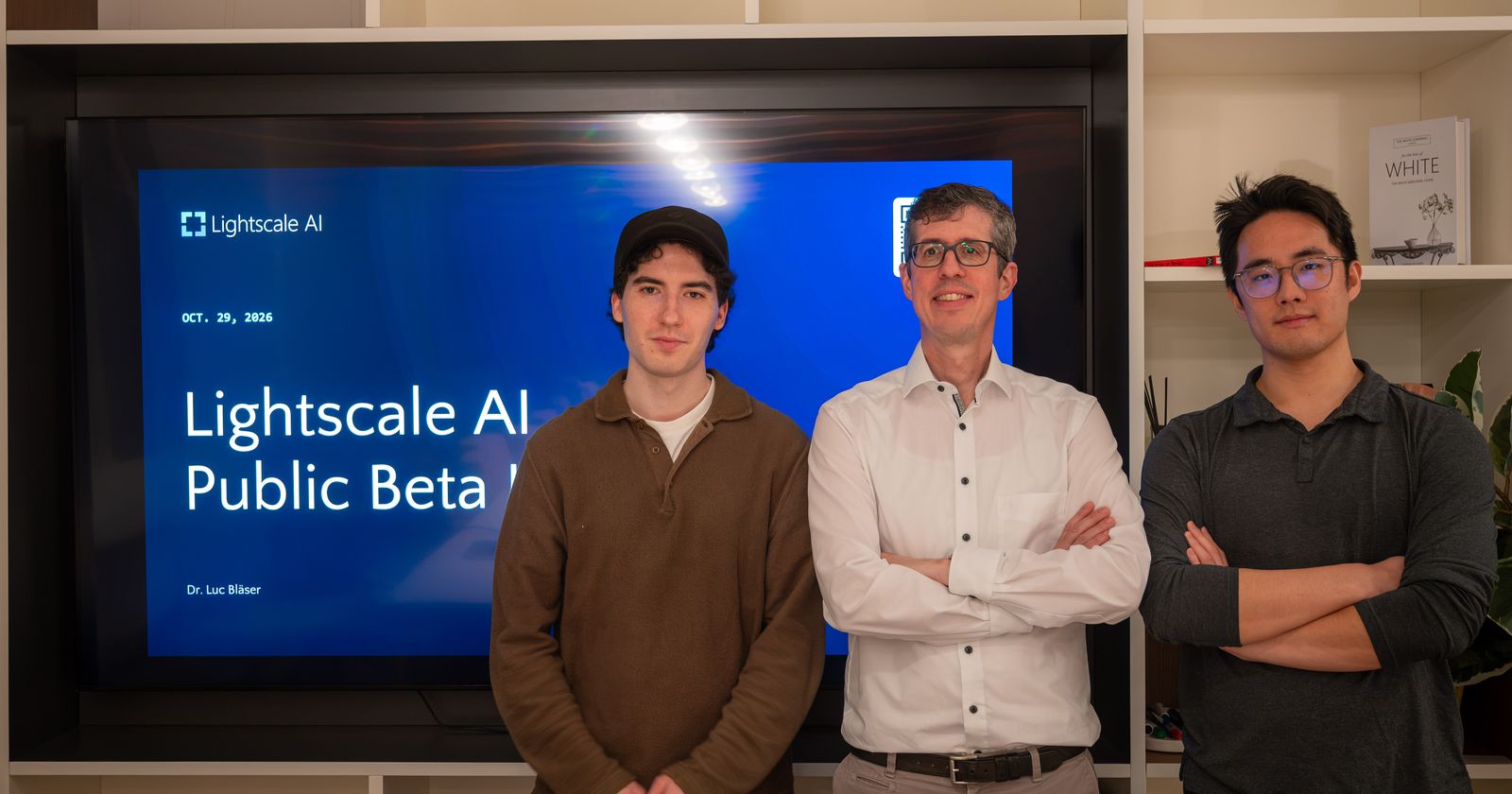
On the evening of October 29, at Signature on Bahnhofquai in Zürich, we opened the Lightscale AI beta to the public. More than forty people came, the room was full, and we ran out of chairs. I presented how Lightscale AI works, and Johannes gave the live demo. Users can now sign up, describe the software their business needs in plain language, and have it built as secure business software, with their data reliably persisted. Prompting is free. There are no credits to buy, and you do not need a credit card.
How we got here
I started working on Lightscale AI full-time on February 1. In the same month, Johannes and I had a booth at START Summit, and on March 2, Lightscale AI Inc. was entered in the commercial register in Zug. I pitched at DTM100 in May, and after that, David joined us. By August, we were running a closed beta with one hundred users, all building their own software in the studio. Now, with the launch, sign-up is open to the public.
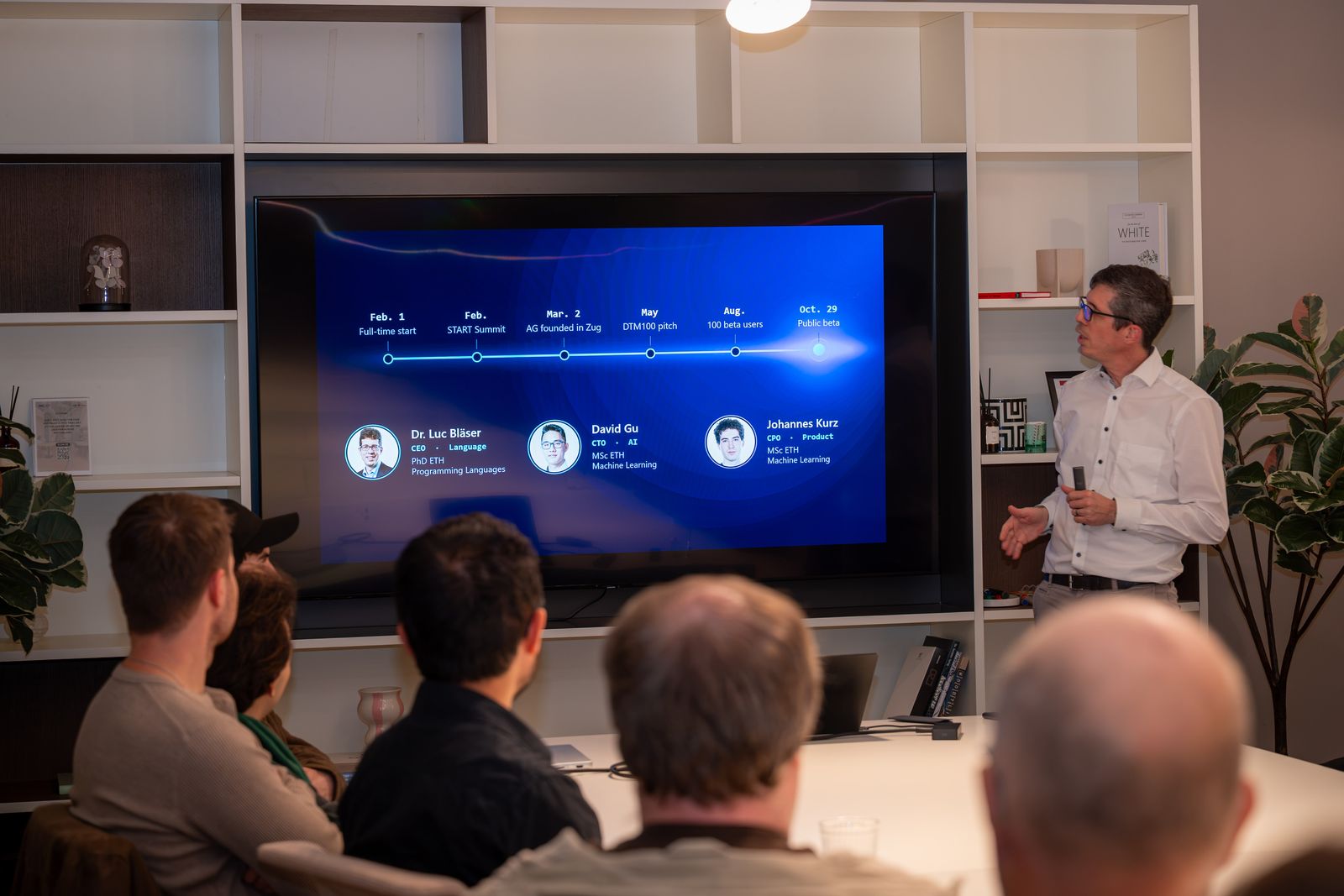
We are three founders, all from ETH Zürich. David Gu, our CTO, and Johannes Kurz, our CPO, studied machine learning. The three of us have worked together before, at Caffeine AI, where I founded the AI team and was the architect, David was a founding engineer, and Johannes worked on LLM post-training. Lightscale AI needs both sides: the AI that writes the software, and the language, compiler, and runtime system that keep it correct.
My own background is in programming languages. I did my PhD in the group of Prof. Dr. Jürg Gutknecht, who built Oberon together with Niklaus Wirth. There I had the honor of working regularly with Niklaus Wirth, winner of the ACM Turing Award, and of following his school of simplicity. Later, I was a professor for eleven years, first at the Hochschule für Technik Rapperswil (HSR) and then at OST, the Eastern Switzerland University of Applied Sciences, into which HSR merged. When OST was founded, I became the first head of its Department of Computer Science and a member of its executive board.
Why we built it
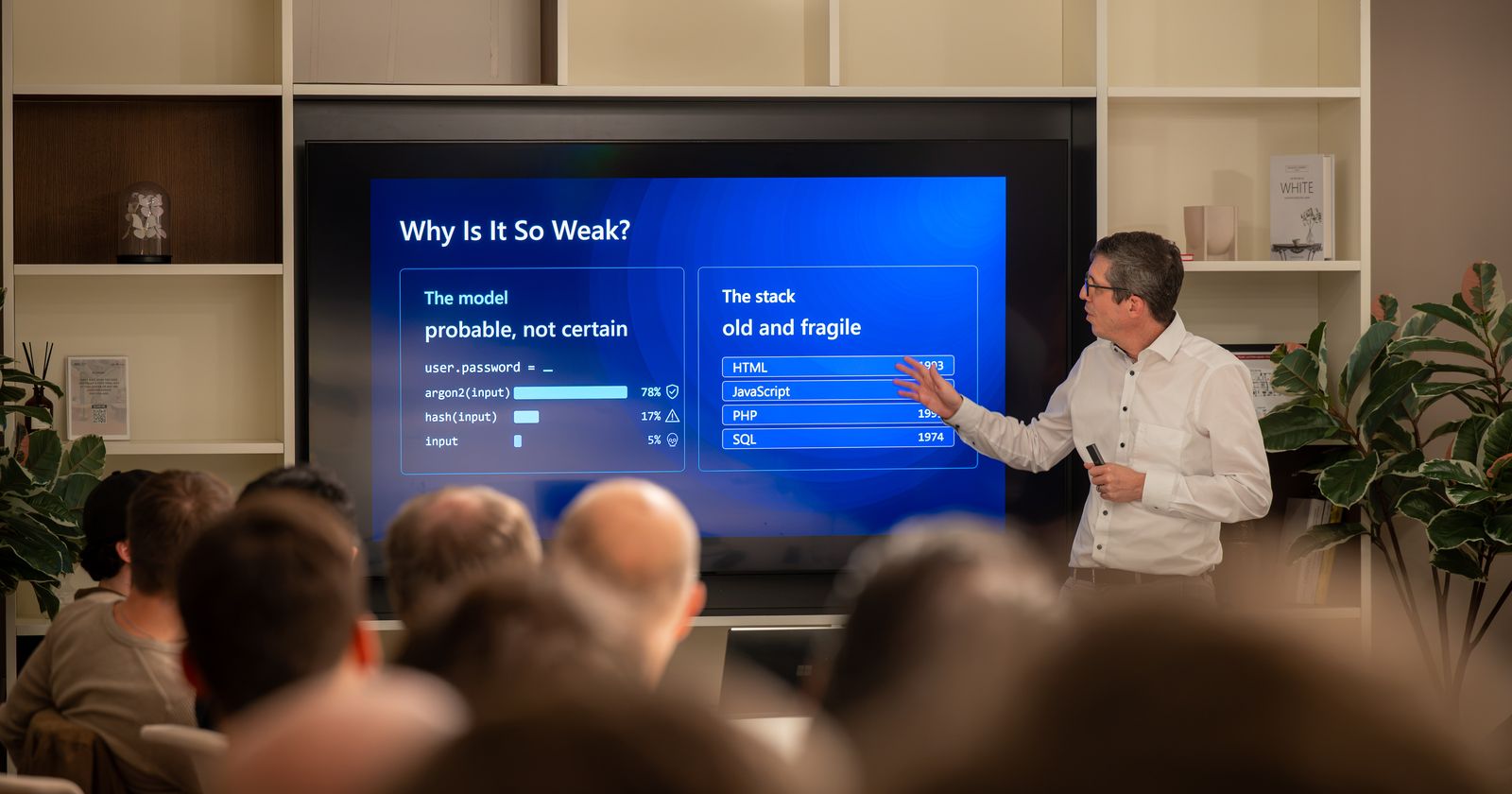
With the immense advances of the past year, AI has become a strong coder. It knows every framework, and it has a polished demo ready in about ten to thirty minutes. As an architect, however, it is currently still weak. Behind the polished screens, AI-generated software almost always has security gaps and bugs, occasionally loses data, and rests on a shaky structure. None of this shows in a demo. Asking the AI to find and fix the problems often ends in long loops, and production-grade software still requires engineering understanding and active guidance.
I see two causes. The first is the stochastic nature of language models. The second, and the cause of most of the problems, is the stack underneath: decades old, notoriously fragile, and insecure by default. This is a pity for our industry. I explain both causes, and our answer to them, in “Why LLMs Need Their Own Programming Language.”
How it works
In Lightscale AI, you start with a description, an Excel file, a template, or any combination of descriptions and reference files. The AI writes a concise program in AI Language (AIL), a programming language I designed solely for AI. Our compiler checks the program, challenges the AI on every coding decision until the program is right, and then builds the complete application: the interface, the workflows, access control, the server, and the database.
You choose where the application runs. We host it on the Lightscale AI platform, or you host it yourself on a standard tech stack of your choice: .NET, Java, or React and Node, with Microsoft SQL Server, Oracle, or PostgreSQL as the database.
What it costs
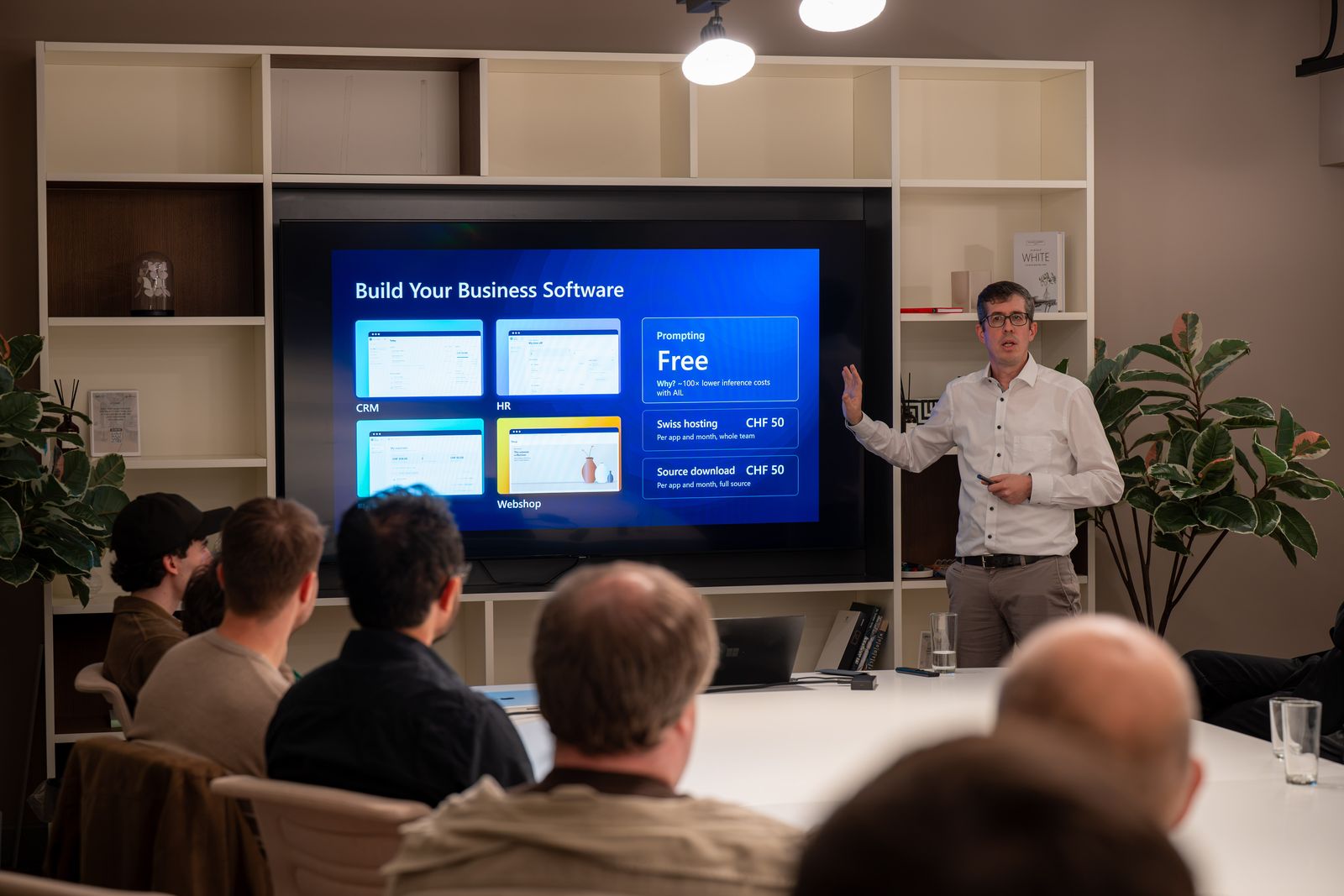
Prompting, building, and changing your software cost you nothing. We can offer this without notable subsidies, because AIL makes inference around a hundred times cheaper than generating conventional code. In August, our closed beta had one hundred invited users prompting actively, and the AI costs came to only around CHF 35 in total. Currently, we rent AI from providers in the US and Europe. For companies, we also offer sovereign AI instances on request.
You pay only to run the application or to take its code. We host the applications on our own stack in Switzerland for CHF 50 per project and month, with your whole team included and no per-user fees. If you prefer to host your applications yourself, the source download costs CHF 50 per project and month. Every change can be synchronized to your Git repository in the tech stack you chose, or you simply download the application, with its updates and data migrations. The pricing page has the details.
Build your own
You can build a CRM, a time-off or HR tool, a finance workflow, an online shop, a company website, or any other business application. Lightscale AI integrates with numerous third-party systems, for example Worldline Saferpay and Stripe for payments, and we keep adding more. If part of your business needs better software, start for free and tell us how it goes.
Thank you to everyone who came to Signature, asked sharp questions, and stayed to talk afterwards, and to our beta users for their feedback.